

The Furniture That Stayed Outside
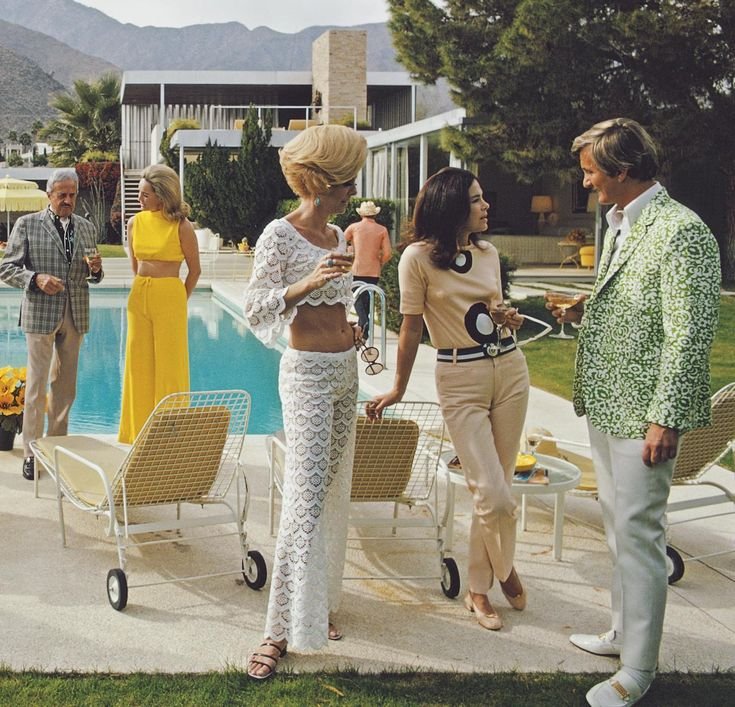
Slim Aarons, "Poolside Party," Palm Springs, 1970. © Slim Aarons / Getty Images.
A Wild & Tame Essay
Slim Aarons spent thirty years photographing people who had figured out how to do nothing beautifully.
The pools. The light. The women draped sideways across wrought iron chairs in the particular way of someone who has nowhere else to be and knows it. His photographs of Palm Springs and Beverly Hills and the Hollywood Hills are not fashion photographs, exactly, and not architecture photographs, exactly — they are photographs of a California that believed outdoor living was not a seasonal activity but a philosophy. That the garden was not the approach to the house but the point of it. That the right chair, in the right garden, in the right afternoon light, was as close to a good life as anything gets.
We have been looking for that furniture ever since.
What Mid-Century Garden Furniture Actually Was
There is a specific category of outdoor furniture made between roughly 1945 and 1975 that has never been improved upon. Not updated. Not reimagined. Not improved.
The wrought iron pieces by Salterini and Woodard — ornate, heavy, black, with scrolled arms and pierced surfaces that threw geometric shadows across pool decks in the afternoon. The Van Keppel-Green chairs out of Los Angeles, woven cord stretched over tubular steel frames in a way that looked like it shouldn't hold a person and held every person beautifully for fifty years. Brown Jordan's aluminum pieces, which brought the clean horizontal lines of California modernism to the garden without sacrificing the warmth that aluminum, counterintuitively, can hold. The Richard Schultz wire furniture for Knoll, designed because Florence Knoll wanted something that wouldn't rust at her Florida home and got, instead, one of the most quietly perfect objects of the twentieth century.
These pieces were made for actual outdoor life — for the California that Slim Aarons documented, where the garden was used all day and into the evening and the furniture was expected to be present for all of it. They were made to weather. Made to patinate. Made to become more interesting as they aged rather than less.
They are still doing that.
Why We Source It
When we bring a piece of vintage mid-century garden furniture into a project, something happens to the garden that no new piece can replicate.
It settles it. It gives it history it didn't have the week before. A 1950s Woodard chair with its original black paint worn soft at the armrests carries fifty years of California afternoons in it — fifty years of someone sitting down with a glass of something cold, looking at a garden, deciding the light was good. That is not a quality that can be manufactured. It can only be accumulated, slowly, the way a garden accumulates itself over seasons.
There is also the matter of proportion. Mid-century garden furniture was designed for the scale of the postwar California garden — generous lots, pools with real depth, patios that understood they were the main room of the house for eight months of the year. The pieces have a presence. They occupy space with confidence. They do not apologize for taking up room.
We source these pieces constantly — estate sales in Palm Springs and Pasadena, dealers who specialize in the California modernist period, the occasional extraordinary find at an auction house that hasn't figured out yet what it has. We look for the patina of genuine use: the wrought iron that has been repainted once or twice with slight variations in color at the joints, the aluminum that has gone from bright to a matte silver-grey that catches the late afternoon light better than it ever did new, the cushions we almost always replace, in linens and outdoor textiles that carry the same color intelligence as the era without pretending to be original.
The Contrast That Makes Both Things More
Here is what we have learned from years of placing these pieces in native and naturalistic gardens:
The contrast between the clean geometry of mid-century furniture and the soft, spilling wildness of a native California planting is not a tension. It is a conversation. And it is the most visually interesting conversation a garden can have.
A Woodard wrought iron table surrounded by white sage and Matilija poppy and the silver sprawl of Artemisia. A pair of Van Keppel-Green chairs at the end of a flagstone path where the paving gives way to a native meadow planting that has decided it will not stay on its side of the line. A Brown Jordan chaise longue in faded aluminum positioned so that the morning sun comes through the flowerheads of a California fuchsia and lands on the surface like something deliberate.
The furniture says: someone thought about this. The planting says: and then something else happened. That is Wild & Tame in a single frame. The tame and the wild in direct proximity, each making the other look exactly right.
Thomas Church, the landscape architect who defined California garden design in the mid-century period, understood this intuitively. His gardens — the kidney pools, the serpentine lawns, the eucalyptus casting shadows over concrete — were always balanced between the designed and the allowed. He knew that a garden needed structure to hold the wildness, and wildness to make the structure feel alive rather than merely correct.
The furniture carries that same intelligence. It is the structure. The planting is the wildness. Neither is complete without the other.
The Woman Who Sits in This Chair
She is not decorating a patio. She is not completing a look.
She is someone who understands that the objects around her carry history, and that history is a form of beauty she cannot buy new. She found the chair at an estate sale in La Cañada on a Saturday morning before it got hot, and she knew immediately — the weight of it, the specific curve of the arm, the way the paint had worn to something softer and more interesting than paint — that it belonged in her garden. Not as a prop. As a presence.
She will sit in that chair for twenty years. It will look better in twenty years than it does today. The garden around it will have grown into it, leaned toward it, decided that it was always supposed to be there.
That is the thing about objects that were made to last: they become part of the place. They stop being furniture and start being evidence — of taste, of time, of the specific quality of attention a person brought to the building of a life.
We source for that. We design for that.
Every garden we make is full of things that were already somewhere else before they arrived — plants that evolved over millennia for this specific latitude and light, furniture made in the middle of the last century for a California that knew how to sit still, stone and terracotta and wood that carry the marks of other hands. We bring these things together and call it a garden, and what we mean is: something that feels like it has always been here.
Something that feels, in the best possible way, like it was found.
Wild & Tame sources, styles, and designs with vintage mid-century garden furniture as part of our full garden design practice. We work throughout Los Angeles. wildandtame.co